Beginner Gym Workout Plan: 3 Days a Week, Full Body | Trainer.sg
A Simple Beginner Gym Workout Plan (3 Days a Week)
A three-day full-body beginner gym workout plan with two alternating workouts, sets, reps and rest, how to pick your weights, how to progress, and what to expect in 8 to 12 weeks.
Walking into a gym without a plan is how most people end up wandering between machines, doing a bit of everything and not much of anything. A beginner gym workout plan fixes that. This one uses three full-body sessions a week, two alternating workouts and a handful of basic movements, so you always know what to do when you walk in and you can see yourself getting stronger from week to week.
It's built for people who are new to lifting or coming back after a long break. You don't need a barbell, a training partner or a lot of time: each session takes about 45 to 60 minutes including the warm-up.
The plan at a glance
Train 3 days a week with at least one rest day between sessions, for example Monday, Wednesday and Friday.
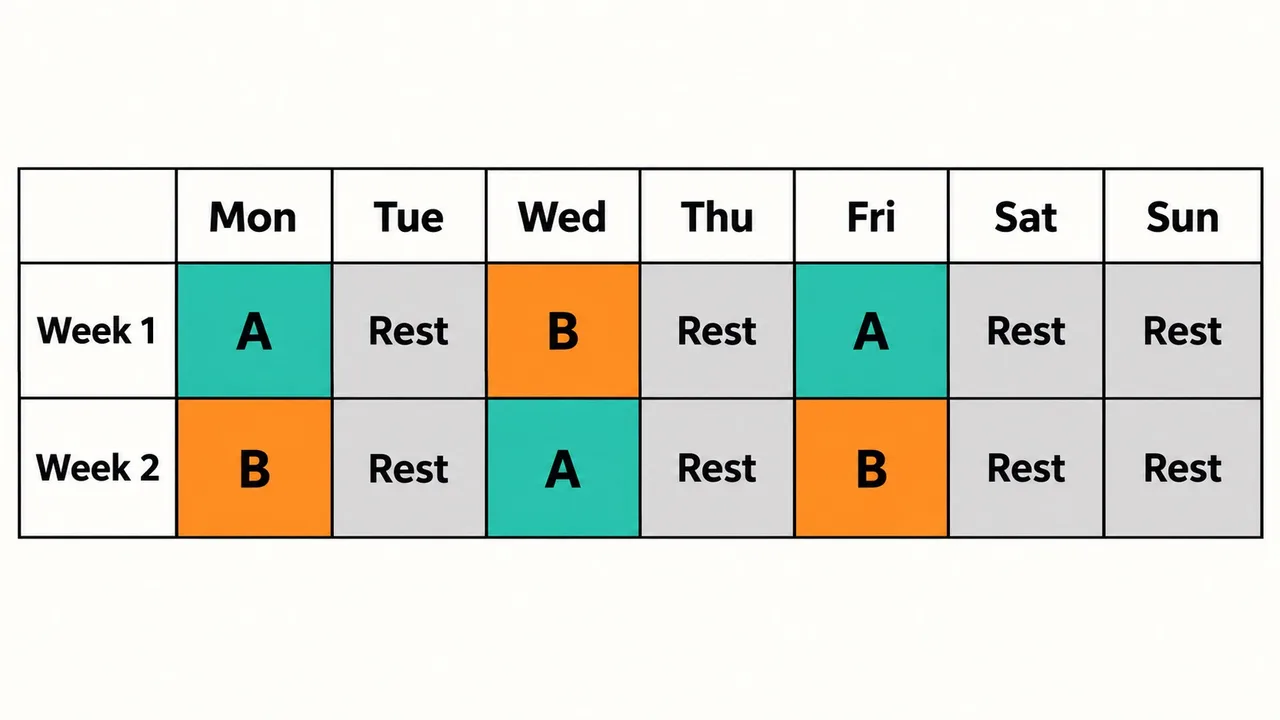
Alternate two workouts, A and B. Week 1 is A, B, A. Week 2 is B, A, B. Then repeat.
Every session works the whole body: a squat, a hinge, a push, a pull, and a carry or core exercise.
Most sets stop with 2 to 3 reps still in the tank. You should finish each set feeling like you could have done a couple more with good form.
Add reps first, then weight. When you hit the top of the rep range on every set, move up to the next weight.
Why full body? When you're new, each muscle responds well to being trained two or three times a week, and full-body sessions make that easy. They're also forgiving: if you miss a day, you haven't skipped "leg day" for the week. Three sessions also comfortably meets the WHO recommendation of muscle-strengthening activity on two or more days a week.
Workout A and Workout B
Each workout has five exercises. Do them in the order listed, finishing all sets of one exercise before moving to the next. The bigger movements come first, while you're fresh.
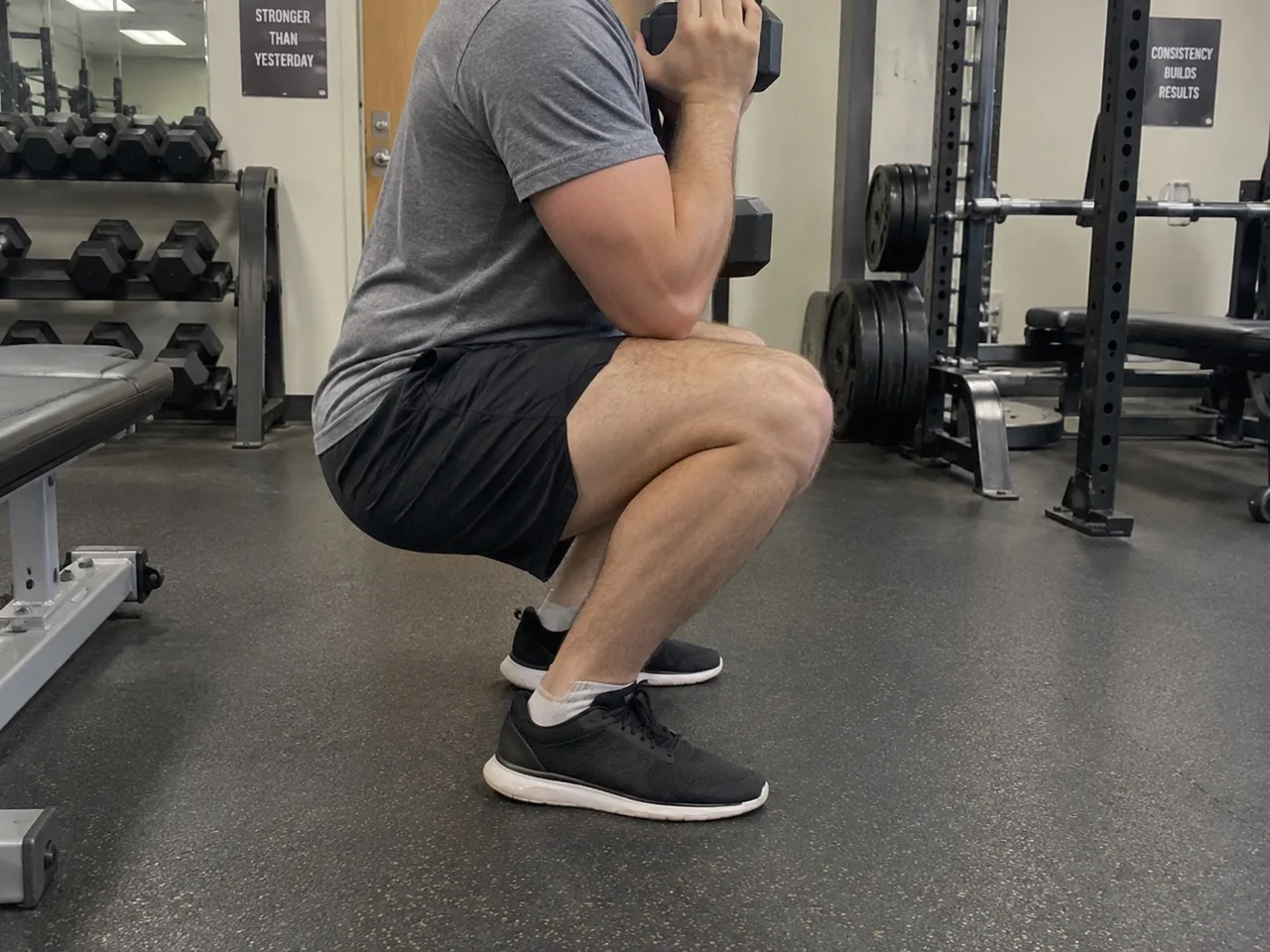
Goblet squat: hold one dumbbell vertically against your chest, feet about shoulder-width apart, and sit down between your heels. Keep your chest up and your heels flat. It's one of the easiest squat variations to learn because the weight in front helps you stay upright.
Romanian deadlift (RDL): with soft knees, push your hips back and slide the dumbbells down the front of your legs until you feel a stretch in your hamstrings, usually around mid-shin. Keep your back flat, then drive your hips forward to stand up. It's a hinge, not a squat.
Rows and pulldowns: pull with your elbows, not your hands, and finish with your shoulder blades drawn back and down. Don't lean back and swing the weight.
Farmer's carry: pick up a heavy dumbbell in each hand, stand tall and walk. It trains grip, core and posture all at once.
In a goblet squat the weight stays close to your chest and your heels stay down.
Your weekly schedule
Any three non-consecutive days work. Monday, Wednesday and Friday is the classic choice, but Tuesday, Thursday and Saturday is just as good. What matters is a day of rest, or light activity, between sessions so you recover.
Alternate A and B so each workout comes up three times every two weeks.
On rest days, walking, cycling or any easy movement you enjoy is a good idea. The WHO also recommends 150 to 300 minutes of moderate aerobic activity a week for adults, and a daily walk covers a lot of that. If you're short on time, small daily fitness habits are an easy way to fill the gaps.
If you miss a session, don't try to double up. Just do the next workout in the sequence on your next gym day.
How to warm up
A good warm-up takes about 5 to 10 minutes. It doesn't need to be complicated:
3 to 5 minutes of easy cardio on a bike, rower or treadmill, enough to feel slightly warm.
A few mobility moves: 10 bodyweight squats, 10 hip hinges with your hands on your hips, and 10 arm circles each way.
Warm-up sets for the first exercise. Do one set of 8 with a light weight, then one set of 5 with something closer to your working weight. Only the sets after that count as working sets.
Later exercises in the session usually need only one light warm-up set, since you're already warm.
How to choose the right weight
This is the part most beginners get wrong in both directions: either the weight is so light it does nothing, or so heavy that form falls apart. The simplest tool is reps in reserve (RIR): how many more reps you could have done with good form when you stopped the set.
How the set felt
Reps in reserve
Effort (RPE)
What to do
Easy, could have done many more
5+
5 or less
Go heavier next set
Challenging, last reps slowed down a bit
2–3
7–8
This is the target zone
Very hard, maybe one more rep
1
9
Fine occasionally, don't live here
Couldn't finish the rep, or form broke
0
10
Go lighter next time
RPE stands for rate of perceived exertion, a 1 to 10 scale where 10 is an all-out effort. RPE 8 means about 2 reps left in reserve. You don't need to be precise. Beginners are often poor at guessing how close they are to failure, so if you're unsure, err on the side of a little lighter with perfect form.
For your first session, start lighter than you think you need. Do one set of the exercise with a weight you're confident about. If you could have done 5 or more extra reps, go up for the next set. By the end of week 1 or 2 you'll have found a working weight for every exercise.
Progressive overload: how to keep improving
Your body adapts to what you ask of it, so the demand needs to creep up over time. That's progressive overload. For beginners, the easiest method is double progression:
Pick a weight you can lift for the bottom of the rep range (say 8 reps) on every set, with 2 to 3 reps in reserve.
Each session, try to add a rep or two to some of your sets while keeping good form.
When you hit the top of the range (say 12 reps) on all sets, move up to the next weight.
Your reps will drop back toward 8 with the heavier weight. Build them back up and repeat.
With dumbbells, the next weight is usually 1 to 2.5 kg heavier per hand. On machines, it's the next plate on the stack. Lower-body exercises tend to progress faster than upper-body ones, and pressing movements like the shoulder press are often the slowest. That's normal.
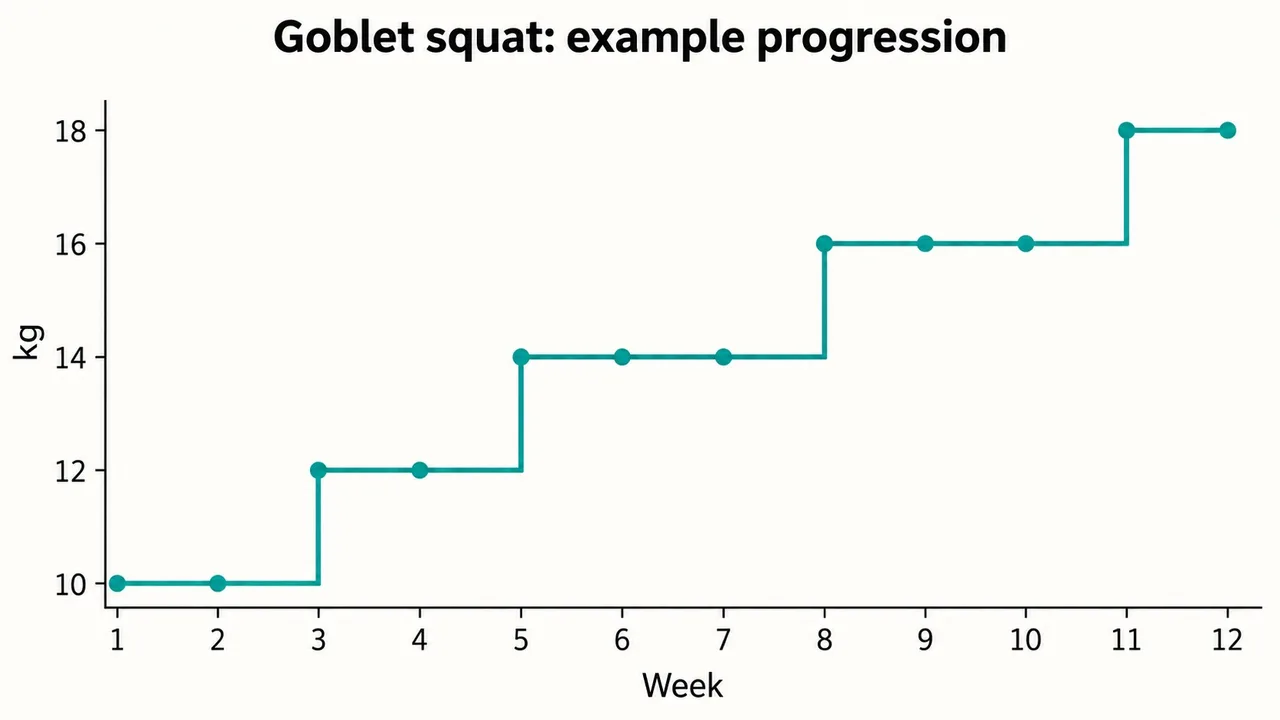
An example of double progression. The weight goes up in steps, with weeks of adding reps in between.
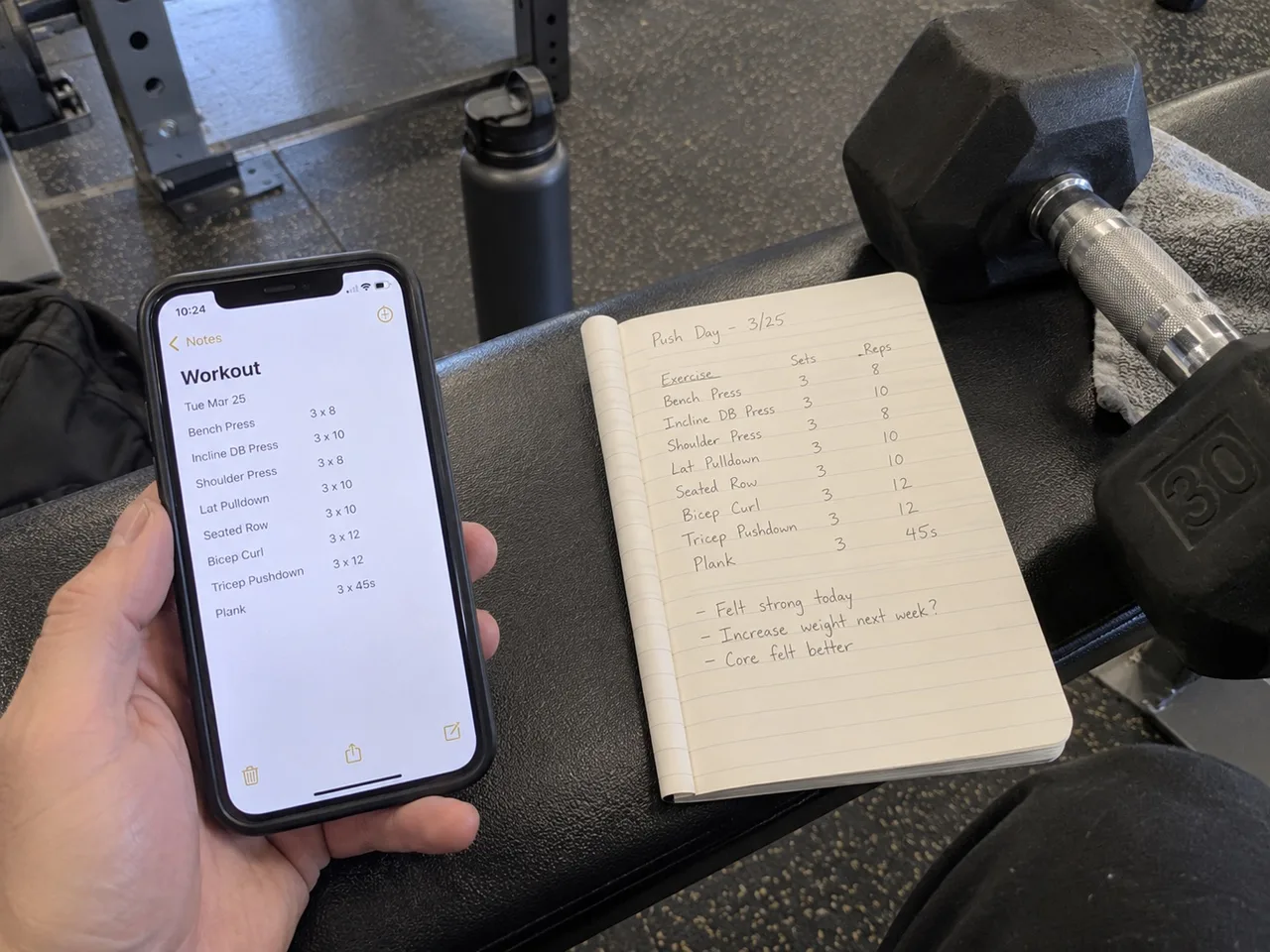
Write everything down. You won't remember that you did 14 kg for 10, 10 and 9 reps last Wednesday, and the log is what tells you whether to add a rep or a kilo today. A notes app, a spreadsheet or a paper notebook all work.
Any log works, as long as you check it before each session.
When progress stalls
Sooner or later, you'll get stuck on an exercise for two or three sessions in a row. Before changing anything, check the basics: are you sleeping reasonably well, eating enough protein (around 1.6 g per kg of body weight a day is a common target for muscle gain, see how much protein you need per day), and actually turning up three times a week? If the answer is yes, drop the weight by about 10%, build back up over a couple of weeks, and you'll usually move past the sticking point.
Substitutions for machines, dumbbells and busy gyms
Every gym is different, and sometimes the equipment you want is taken. Swap within the same movement pattern and keep the same sets and reps.
Movement
In the plan
Swap with
Squat
Goblet squat, leg press
Hack squat machine, box squat, barbell back squat once confident
Hinge
Dumbbell Romanian deadlift
Barbell RDL, cable pull-through, hip thrust or glute bridge
Push (horizontal)
Dumbbell bench press
Chest press machine, push-ups (on a bench if needed)
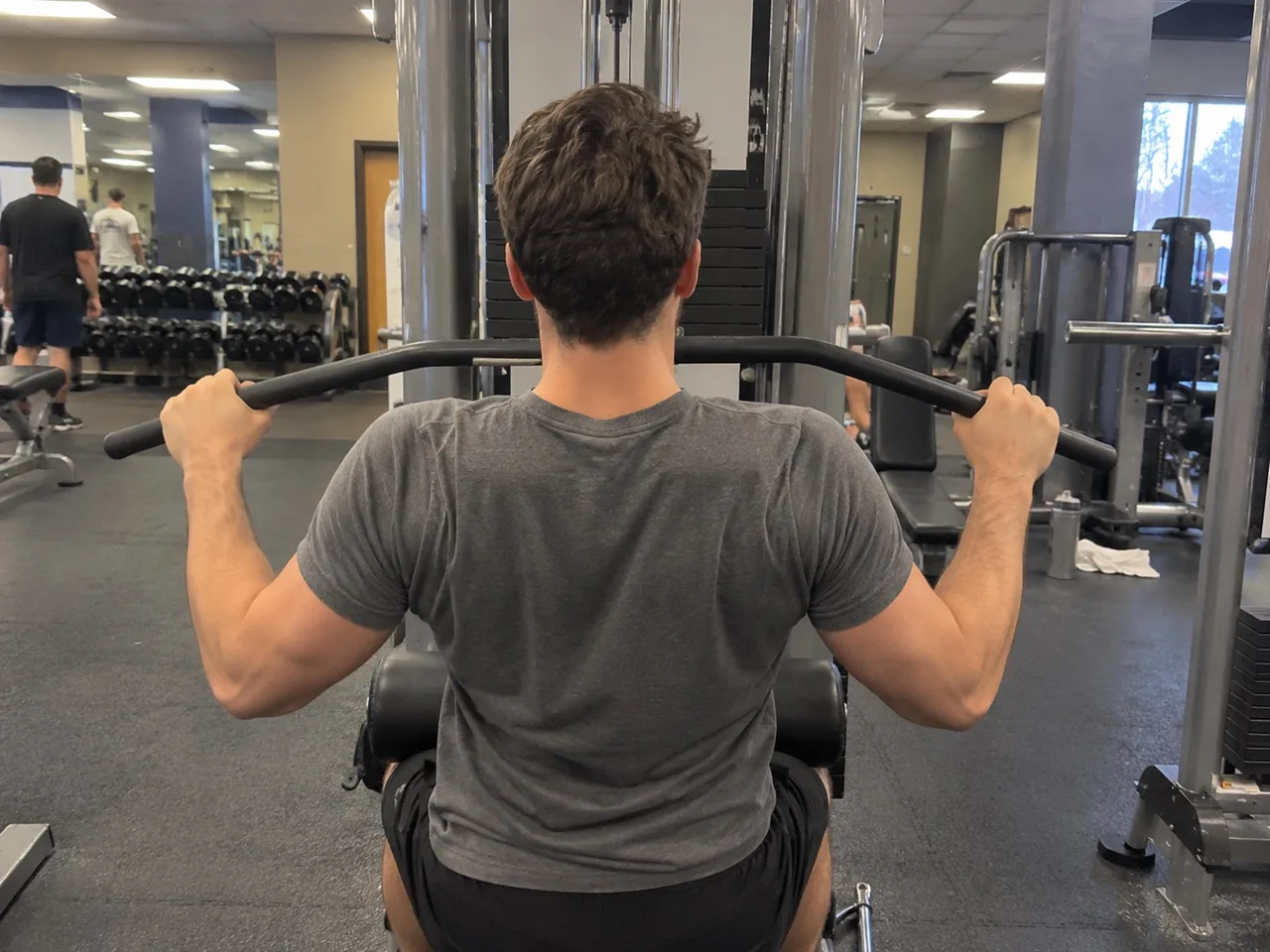
Machines like the lat pulldown are a beginner-friendly way to train your back.
What to expect in 8 to 12 weeks
If you train consistently and progress steadily, here's a realistic picture:
Weeks 1 to 2: You'll feel sore after the first few sessions. That's expected and fades quickly as your body gets used to the work. Focus on learning the movements and finding your weights.
Weeks 3 to 6: Strength goes up quickly, often from one session to the next. Much of this early gain comes from your nervous system getting better at the movements, not just new muscle.
Weeks 6 to 12: Progress slows a bit but keeps coming. Most people notice clothes fitting differently, everyday tasks feeling easier, and lifts that are clearly heavier than in week 1. Visible muscle changes build more gradually and depend a lot on your nutrition and sleep.
Results vary from person to person, so compare yourself with your own log, not with someone else's. If your goal is fat loss, pair the plan with a sensible calorie target. Our guide on how many calories you should eat walks you through it.
After about 12 weeks, many people are ready for a bit more volume, such as adding a set to the main lifts, or for a four-day upper/lower split. If you're still progressing on this plan, there's no rush to change it.
Common beginner mistakes
Doing too much too soon. Five sessions a week of hard training in week 1 often ends in burnout or sore joints by week 3. Three sessions you actually complete beat five you dread.
Changing the program every week. You can't progress on an exercise you only do once. Stick with the same plan for at least 8 weeks.
Ego lifting. Adding weight while your form gets sloppier isn't progress. Range of motion and control come first.
Training to failure on every set. It makes recovery harder and form worse. Leave 2 to 3 reps in reserve on most sets.
Skipping the log. Without one, you end up guessing, and guessing usually means lifting the same weights for months.
Ignoring sleep and food. Training is the signal. Sleep, protein and enough total food are what let your body respond to it.
Quitting after a missed week. Life happens. Restart at slightly lighter weights and pick up where you left off. If this keeps happening, read why you keep quitting the gym.
When to get a trainer to check your form
You can learn this plan on your own, and plenty of people do. But a few sessions with a qualified personal trainer can save you months of trial and error, especially if:
You've never lifted before and want to learn the squat and hinge properly from the start.
Something pinches or hurts during a lift, rather than just feeling like hard work.
You've been stuck on the same weights for several weeks despite sleeping and eating well.
You have a past injury, a health condition or a goal that needs a more tailored plan.
If you have heart, joint or blood pressure concerns, are pregnant, or are returning after an injury or surgery, check with your doctor before starting a new exercise program. Stop any exercise that causes sharp pain, dizziness or chest discomfort.
FAQ
What is a good beginner gym workout plan?
A good beginner plan trains the whole body two or three times a week using a few basic movements: a squat, a hinge, a push, a pull, and a carry or core exercise. It uses moderate weights, tracks your lifts and adds reps or weight gradually. The three-day A/B plan above follows that structure.
Is 3 days a week enough to build muscle?
Yes. For beginners, three full-body sessions a week train every major muscle group several times, which is plenty to build strength and muscle. Consistency over months matters far more than the number of days.
How long should a beginner workout be?
About 45 to 60 minutes, including a 5 to 10 minute warm-up. If you're short on time, keep the first three exercises and drop the last two for that session.
How many sets and reps should a beginner do?
Two to three sets of 8 to 12 reps per exercise is a solid starting point, with each set ending about 2 to 3 reps short of failure. That's enough to drive progress without leaving you wrecked for days.
Should beginners use machines or free weights?
Both are fine. Machines are easier to learn and safer to push close to your limit, while dumbbells and barbells build coordination and work more muscles at once. This plan mixes the two on purpose.
How long until I see results from lifting weights?
Most people notice strength gains within the first few weeks. Visible changes in muscle and body shape usually take longer, often two to three months of consistent training, and depend on your nutrition, sleep and starting point.
Should I do cardio on the same day as weights?
You can. If you do both in one session, lift first while you're fresh, then do your cardio. Easy cardio on rest days, like walking or cycling, also works well.
The bottom line
The best beginner gym workout plan is a simple one you follow for months. Train three days a week, alternate Workout A and Workout B, leave a couple of reps in the tank, write down what you lift and add a rep or a little weight whenever you've earned it. Do that for 12 weeks and you'll be noticeably stronger, more confident in the gym and ready for whatever comes next.