Why You Keep Quitting the Gym: How to Stay Consistent | Trainer.sg
Why You Keep Quitting the Gym (and How to Stay Consistent)
Lost your gym motivation again? It's not a willpower problem. Here's why most people quit the gym within a few weeks, and simple ways to stay consistent even on bad weeks.
You signed up in January. You went four times the first week, three the next, and you even bought the nice water bottle. Then work got busy, you caught a cold, a friend's birthday landed on leg day, and somewhere around week six the gym quietly became that place you're "definitely going back to on Monday".
If that sounds familiar, you're in very good company. Most people don't quit the gym because they're lazy or because they don't care. They quit because the way they started was never built to survive a normal, messy life. The good news is that this is very fixable, and it has a lot less to do with motivation than you'd think.
Why motivation to work out never lasts
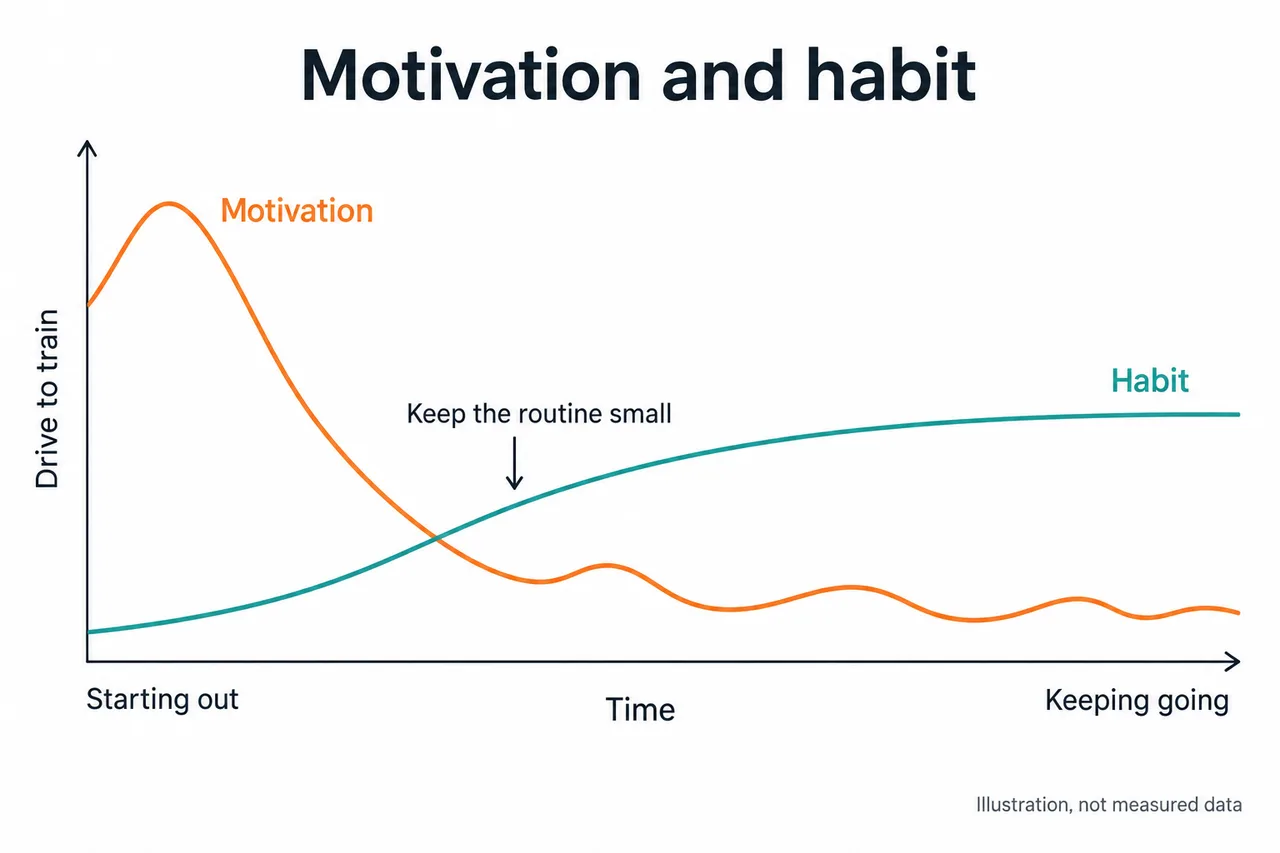
Motivation is brilliant at getting you started. It's terrible at keeping you going. It shows up after a bad photo, a doctor's visit or a new year, gives you a huge burst of energy, and then fades, usually right around the time the novelty wears off and the soreness kicks in.
The mistake is building your whole routine on top of that burst. When you're riding high, five sessions a week and a clean diet feel totally doable. Three weeks later, with the same plan and a fraction of the energy, it feels like a second job. You don't fail the plan so much as the plan was sized for a version of you that only exists for a few weeks.
People who stay consistent at the gym for years aren't more motivated than you. They've just stopped relying on motivation. Training has become something they do, the same way brushing your teeth isn't something you need to feel inspired about.
Habits help when motivation fades.
The real reasons you keep quitting the gym
When you look closely at why people drop off, the same few patterns show up again and again.
The first is the all-or-nothing plan. You commit to an hour, five days a week, and the moment you can only manage 20 minutes, it feels pointless, so you do nothing. Miss one session and the week feels "ruined". Miss a week and you decide you'll restart properly next month. The bar was so high that anything less than perfect counted as failure.
. For the first couple of months, the changes are real but small. You lift a little more, you're a bit less puffed on the stairs, but the mirror looks about the same. If you're not writing anything down, it genuinely feels like nothing is happening, and it's hard to keep showing up for nothing.
The third is that nobody notices. If you skip Tuesday's session, the only person who knows is you, and you're very good at negotiating with yourself. "I'll go tomorrow" is easy to say when there's nobody around to ask how tomorrow went.
And finally, there's no plan for bad weeks. Late nights at work, a sick kid, a holiday, a bout of flu. Life will throw these at you every few weeks, and if your routine only works when everything else is calm, it's going to break regularly.
How to stay consistent at the gym (even when you don't feel like it)
The fix isn't trying harder. It's designing a routine that still works on your worst week.
Start by shrinking the commitment until it feels almost too easy. Two or three sessions a week that you actually do will beat five that you do for a month. If you're not sure where to land, the general public-health guideline is around 150 minutes of moderate activity a week plus a couple of strength sessions, which is a lot less than most January plans.
Next, decide on a minimum workout. This is the version you do when you're tired, busy or just not feeling it: maybe 20 minutes, three exercises, done. The rule is simple: on a bad day, you're allowed to do the minimum, but you still show up. Most of the time, once you're there, you'll do more anyway. And even when you don't, you've kept the habit alive, which is the whole point.
Then give your workouts a fixed slot. "I'll go when I have time" almost never works, because you'll never have time. "Monday, Wednesday and Saturday, straight after work" does, because it removes the daily decision. Pack your bag the night before, or keep a spare set of gym clothes at the office, so starting is as easy as possible.
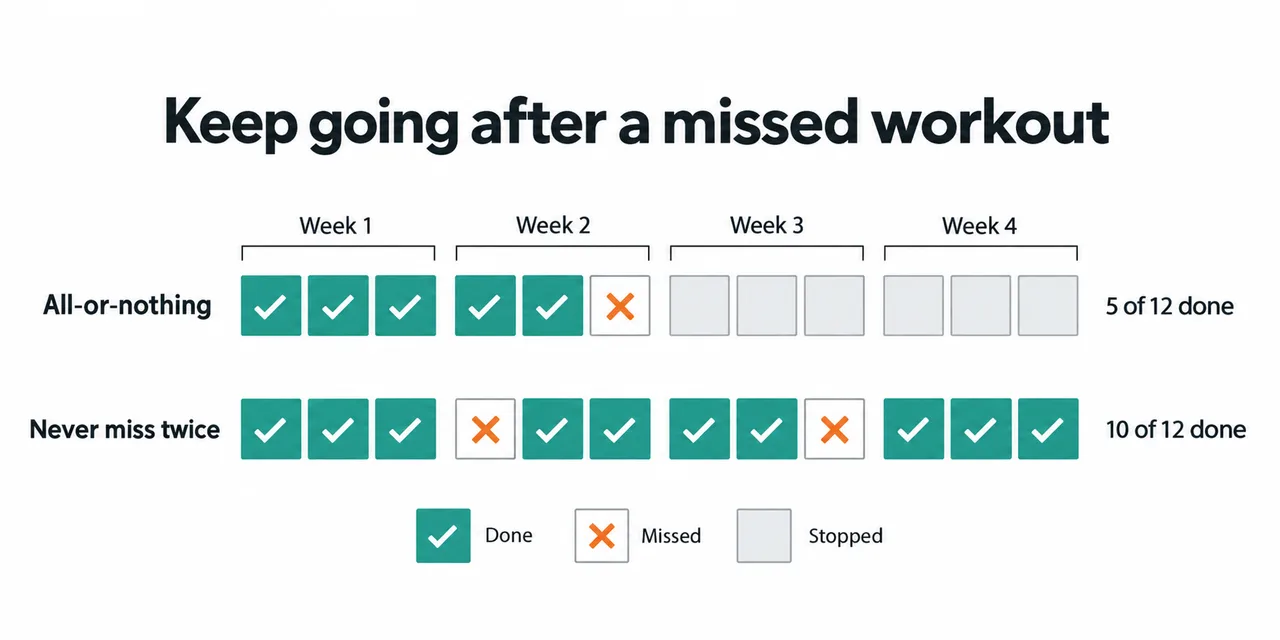
Finally, adopt the rule that's saved more fitness routines than any programme: never miss twice. Missing one session is normal and doesn't matter. Missing two in a row is how a break turns into quitting. Interestingly, one well-known study on habit formation from University College London found that missing a single day didn't really affect how well people built a habit. What mattered was getting back on track straight after.
One missed workout does not have to end the routine.
Make your progress visible
Remember that invisible progress problem? The easiest way to solve it is to start keeping score.
It doesn't need to be complicated. Jot down your main lifts and how many reps you got. Take a photo and your weight every week or two at the same time of day. Note how many days you trained. After a month, you'll have actual proof that you're getting somewhere, even if the mirror hasn't caught up yet, and that proof is surprisingly motivating on the days you're dragging your feet.
A short weekly reflection helps too. Just a couple of honest questions on a Sunday: how many sessions did I do, what got in the way, and what's one thing I'll do differently next week? It turns a vague feeling of "I've been bad this week" into something you can actually fix.
A few minutes to review the week.
Accountability: the gym motivation hack that actually works
Here's the thing most people don't want to hear: the single biggest difference between people who stick with training and people who don't is often just that someone else is paying attention.
This is a big part of why working with a personal trainer helps, and it's not only about the workouts. When you know a coach is going to look at your week, you're far less likely to talk yourself out of Thursday's session. When they notice you've skipped two in a row, they'll check in before it becomes two months. And when something isn't working, like the 6am sessions you keep missing, they'll help you change the plan instead of letting you feel like a failure.
On Trainer.sg, coaches can set up habits and check-ins for the days between your sessions. A habit might be "train three times a week", "hit 8,000 steps" or "get 30 g of protein at breakfast", and it shows up on your Today screen to tick off, with the last seven days right there so you can see your streak building. Check-ins are short daily or weekly questionnaires your coach builds, so the Sunday reflection we talked about actually happens, and your coach reads it and replies. Client accounts are free, and if you don't have a coach yet, you can find a personal trainer on Trainer.sg.
If you'd rather go it alone, you can still borrow the idea. Tell a friend your training days and send them a quick message after each session. Book a regular class with a mate. Anything that means someone would notice if you didn't turn up.
Your next workout doesn't have to be a good one
If you're reading this because you've fallen off again, please don't wait for Monday, or next month, or for the motivation to come back. Pick the smallest workout you can honestly do this week, put it in your calendar and go. It can be short. It can be mediocre. It just has to happen.
Consistency isn't built from great workouts. It's built from a long line of good-enough ones, with a quick restart every time life gets in the way. Once that clicks, the gym stops being something you keep quitting and starts being something you just do.