How Many Calories Should I Eat to Lose Weight? TDEE Guide | Trainer.sg
How Many Calories Should You Eat to Lose Weight? A Realistic Guide
Work out your maintenance calories, pick a deficit you can actually stick to, keep protein high and adjust based on real results. With worked examples and a reality check on everyday food.
"How many calories should I eat?" is probably the most-Googled nutrition question there is, and the internet's answer is usually either a single magic number (looking at you, 1,200) or a wall of maths with no clue what to do next.
Here's the honest version: there's no universal number, but there is a pretty reliable way to find yours. You estimate what your body burns, pick a sensible goal, eat to that target for a couple of weeks, and then let your real-life results tell you whether to adjust. That's it. The rest is details, and we'll go through them properly below, including how to make it work when you eat out a lot.
The short answer
If you just want the TLDR:
Work out your maintenance calories (your TDEE). This is roughly what you burn in a day, and eating at this level keeps your weight steady.
To lose weight, eat about 275 to 550 kcal below that. That works out to roughly 0.25 to 0.5 kg of fat loss a week, which is a pace most people can actually stick to.
Keep protein high, around 1.6 to 2 g per kg of body weight, so the weight you lose is mostly fat rather than muscle.
Track for two weeks, then adjust. Your calculated number is a starting estimate. Your weekly average weight is the real feedback.
Now let's unpack each of those.
Step 1: Find your maintenance calories (TDEE)
TDEE stands for Total Daily Energy Expenditure. It's every calorie you burn in a day: keeping you alive, walking to the shops, taking the stairs, training, fidgeting through meetings, all of it. Eat at your TDEE and your weight stays about the same. Eat below it and you lose weight; above it and you gain.
Any TDEE calculator you'll find online does the same two things:
Estimates your resting energy (BMR). This is what you'd burn lying in bed all day. The most widely used formula is the Mifflin-St Jeor equation, which uses your sex, age, height and weight.
Multiplies it by an activity factor. The more you move, the bigger the multiplier.
And the activity multipliers most calculators use:
Activity level
What it looks like
Multiplier
Mostly sitting
Desk job, little exercise
1.2
Lightly active
Training 1 to 3 days a week
1.375
Active
Training 3 to 5 days a week
1.55
Very active
Hard training 6 to 7 days a week
1.725
Athlete
Twice-daily training or a physical job
1.9
A quick tip: most people overestimate how active they are. Three gym sessions a week on top of a desk job usually lands you in "lightly active", not "very active". If you're torn between two levels, pick the lower one. It's easier to add food later than to wonder why nothing's moving.
Step 2: Pick a goal you can actually live with
Once you know your maintenance number, your goal decides how far you move away from it. The rule of thumb is that a kilogram of body fat holds roughly 7,700 kcal. Spread that over a week and you get some neat numbers:
Goal
Daily change from maintenance
Good for
Lose 0.5 kg a week
About −550 kcal
Most people with a fair bit to lose who want steady, visible progress
Lose 0.25 kg a week
About −275 kcal
People closer to their goal, busy periods, or anyone who's burned out on dieting before
Stay the same
0
Maintenance, diet breaks, or focusing on performance
Gain 0.25 kg a week
About +275 kcal
Building muscle without piling on unnecessary fat
You'll notice there's no "lose 1 kg a week" option here. That's on purpose. A 1,100 kcal daily deficit is brutal for most people: you're hungrier, your training suffers, you lose more muscle, and the odds of rebounding go way up. Half a kilo a week might feel slow, but it adds up to around 6 kg in three months, and that's the kind of progress that tends to stay off.
This is exactly how the Daily targets calculator in the trainer.sg Food tab is set up. You fill in a few details about yourself, choose your activity level, then tap one of four goal presets: lose 0.5 kg a week, lose 0.25 kg a week, stay the same, or gain 0.25 kg a week. It tells you your maintenance calories and suggests a daily calorie and protein target. Tap "Use these" and your targets are filled in, or type your own numbers if you'd rather.
Why you shouldn't go below a certain number
You'll see 1,200 kcal thrown around a lot as a weight loss target. For a small, mostly sedentary woman it can be a reasonable floor. For a lot of other people, it's a recipe for feeling awful.
Very low intakes make it hard to get enough protein, fibre and micronutrients, they tank your training, and they make the whole thing feel like punishment. That's why the trainer.sg calculator never suggests less than 1,200 kcal for women or 1,500 kcal for men, even if the maths says you could go lower. If your numbers keep landing at the floor, that's usually a sign to pick the slower goal or move a bit more, not to eat less.
One important note: if you're pregnant, breastfeeding, under 18, managing a medical condition like diabetes, or have a history of disordered eating, please speak to your doctor or a registered dietitian before setting a calorie deficit. General calculators aren't built for those situations.
Don't forget protein
Calories decide whether you lose weight. Protein has a big say in what you lose.
When you're in a deficit, your body is happy to break down muscle as well as fat. Eating enough protein, and doing some resistance training, tells it to hang on to the muscle. That's the difference between ending up "smaller" and ending up leaner and stronger.
A good target:
About 2 g per kg of body weight while you're losing weight
About 1.6 g per kg when you're maintaining or building
So for Mei, that's around 124 g a day while she's cutting. For Daniel, it's about 160 g. Fat usually lands around a quarter of your calories, and carbs fill in the rest. You don't need to obsess over the exact carb and fat split. Hit your calories and protein most days, and you're doing 90% of the work.
The reality check: everyday food adds up fast
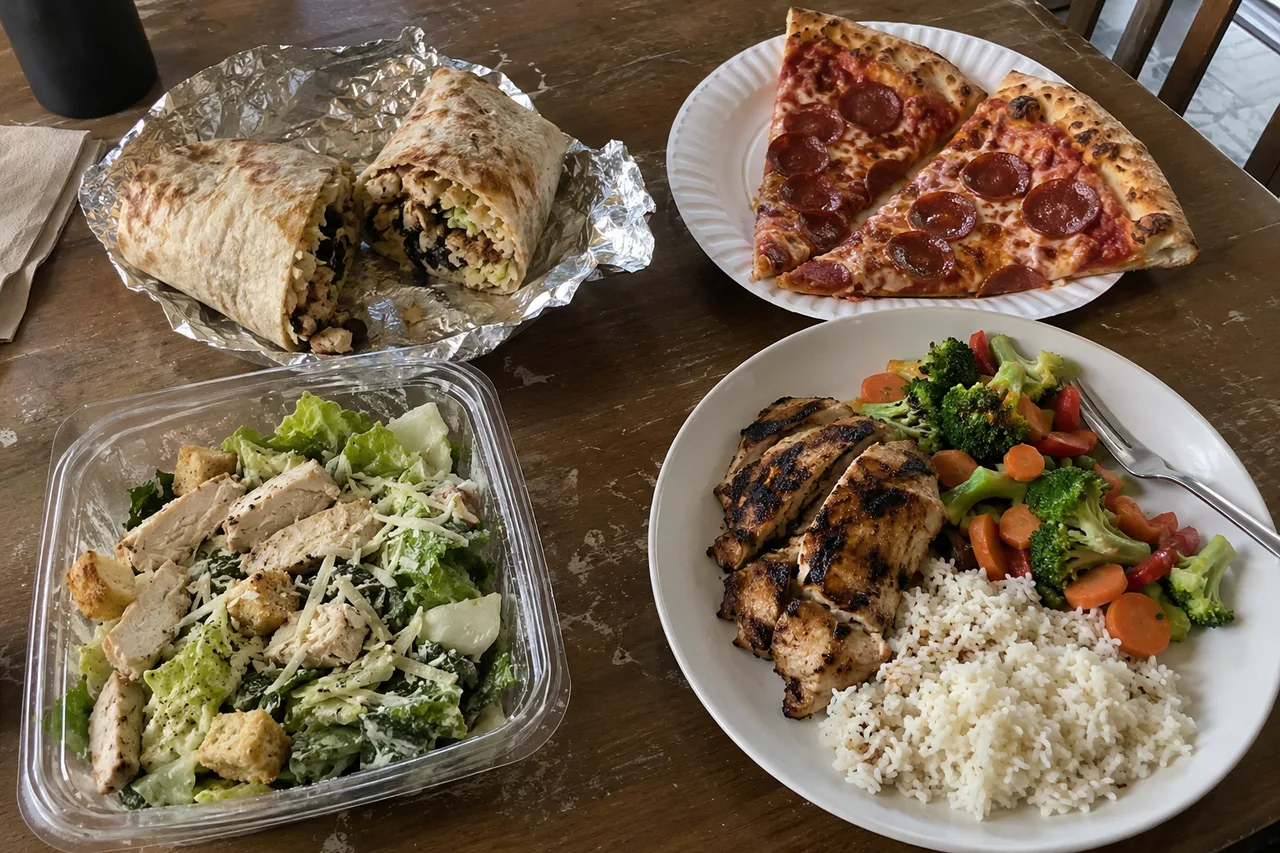
Here's where things get real. You can have a perfect calorie target and still blow past it without realising, because a lot of everyday food is more energy-dense than it looks. Some rough values (they vary a lot by portion and recipe):
Food
Rough calories
Protein
Large chicken burrito
~1,000 kcal
50 g
Pepperoni pizza, 2 large slices
~600 kcal
25 g
Fried chicken sandwich
~650 kcal
30 g
Chicken Caesar salad, with dressing
~500 kcal
35 g
Grilled chicken, rice and vegetables
~550 kcal
45 g
Bakery blueberry muffin
~450 kcal
6 g
Oats with milk and a banana
~350 kcal
13 g
Large latte with whole milk
~220 kcal
12 g
None of these are "bad" foods. But notice the pattern: one big burrito is around two-thirds of Mei's daily target, while the grilled chicken plate gets you most of the same protein for about half the calories. The muffin with your morning coffee is nearly 700 kcal before lunch, and two large lattes a day is more than the whole deficit for a 0.25 kg-a-week goal.
You don't have to give anything up. It's just useful to know where your calories are going, so you can decide what's worth it. Maybe it's the burrito for lunch and something lighter for dinner. Maybe it's a smaller coffee on weekdays and the big one on Saturday. Small, boring swaps like these do most of the heavy lifting.
Calorie counting without the misery
Let's be honest, the reason most people quit tracking isn't the maths. It's the admin. Weighing every grain of rice and searching a database for "my mum's chicken curry, about one ladle" gets old by day four.
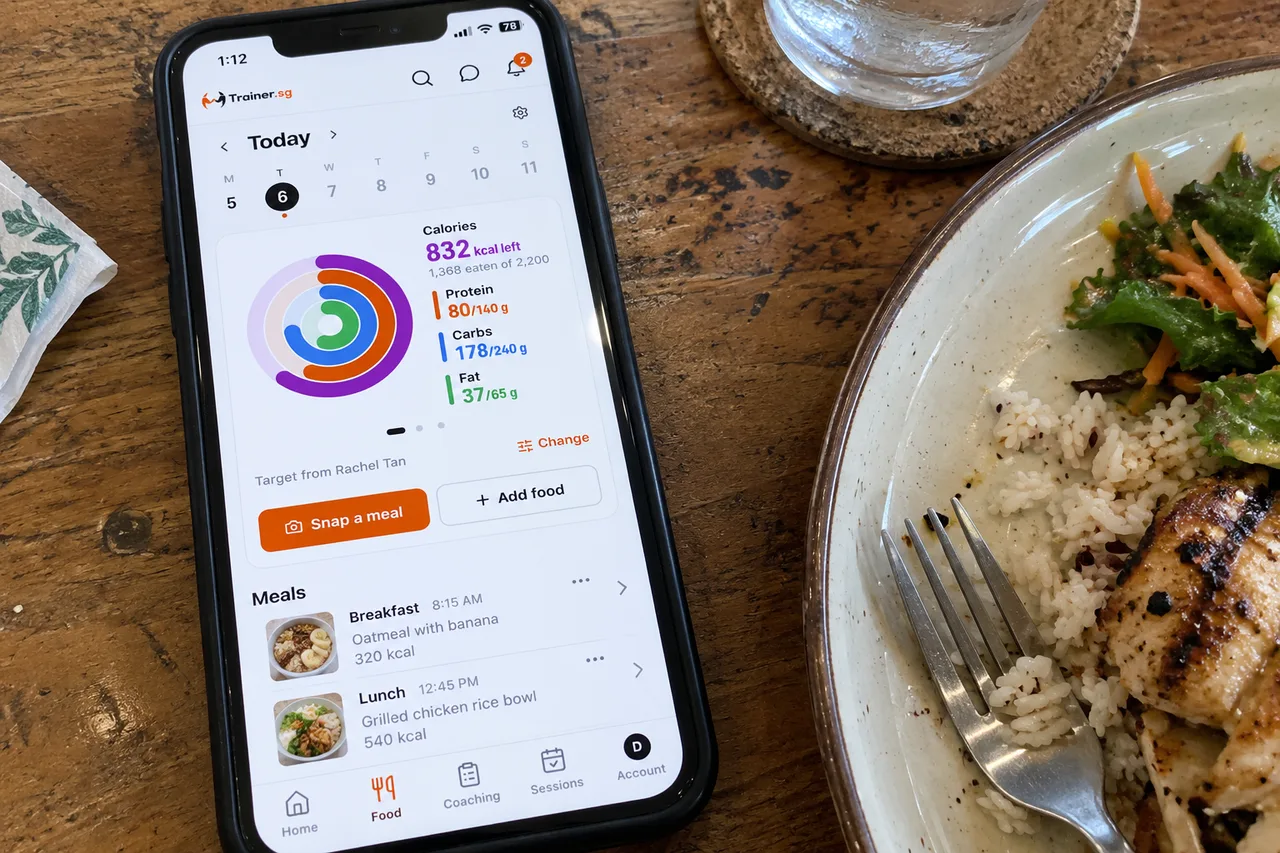
So the trick is to make logging as quick as possible. Here's how the Food tab in trainer.sg handles it:
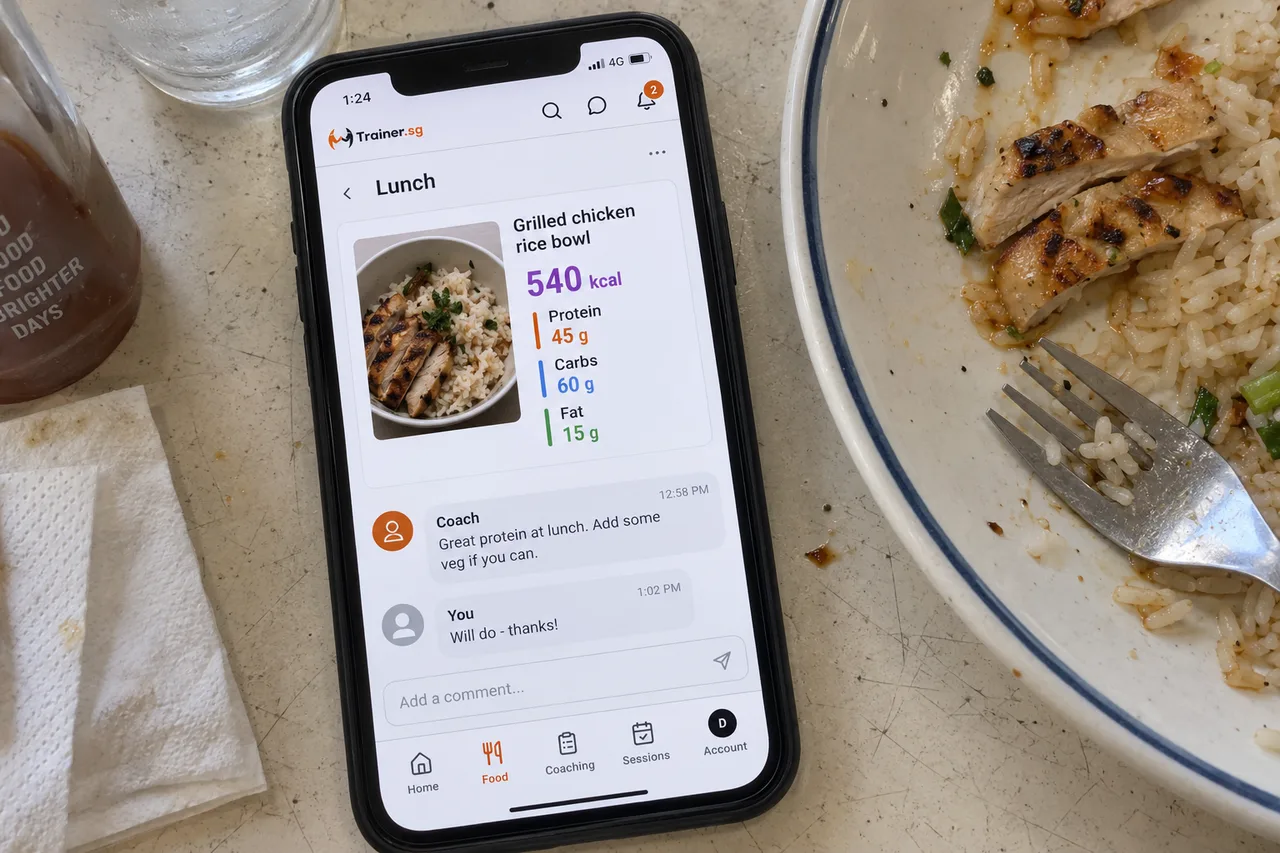
Snap a photo of your meal. Take a picture and you get an estimate of the calories, protein, carbs and fat. You can tweak the portion and the numbers before saving, because no estimate is perfect and you know what was on your plate.
Or just describe it. Type something like "chicken wrap, no mayo, side of fries" and get an estimate the same way.
Scan a barcode for packaged food and drinks, so that protein bar or bottle of iced tea is logged with its label values.
Recent foods and copy yesterday. Most of us eat the same breakfast most days. Log it once, then re-add it in a tap, or copy yesterday's meals when your day looks the same.
A day plate that fills up as you go. A calorie ring shows how much of your target you've used, alongside meters for protein, carbs and fat, so you can see at a glance whether there's room for dessert.
Trainer.sg nutrition tracker
A few habits that make tracking stick:
Log as you eat, not at the end of the day. You'll forget the second coffee. Everyone does.
Aim for "pretty accurate", not perfect. A photo estimate you actually log beats a perfectly weighed meal you skip.
Track the boring stuff too. Sauces, drinks and the "just one" biscuit are where untracked calories hide.
Use trends, not single days
Your daily weight can swing by a kilogram or more from salt, carbs, water, hormones and when you last went to the toilet. If you judge your progress by one morning's weigh-in, you're going to have a bad time.
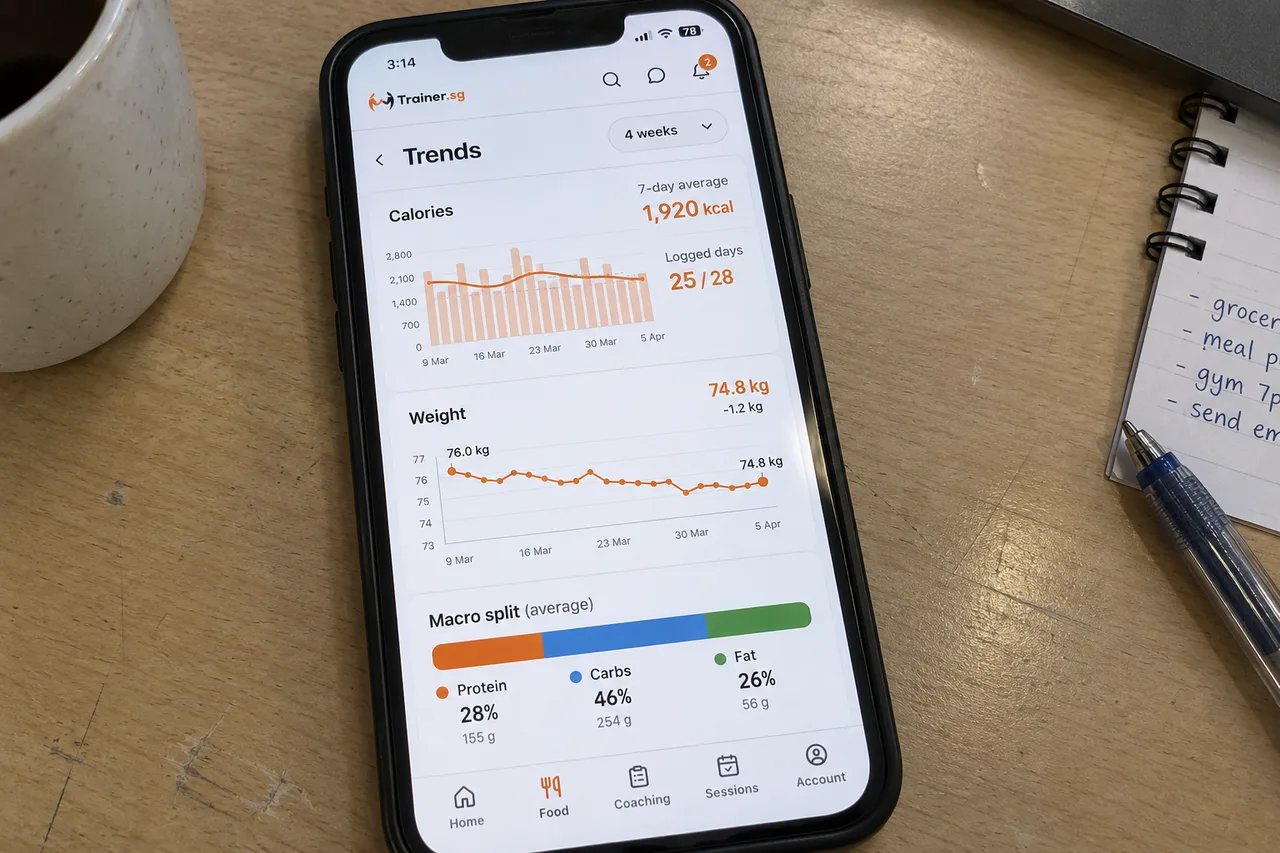
What matters is the trend. In the Food tab you can log weigh-ins alongside your meals, then switch to Trends to see your daily calories next to a 7-day average, how many days you actually logged, and how your protein, carbs and fat split out week by week. That 7-day average is far more honest than any single day, and it's much easier on your mood.
When to adjust your calories
Remember: the calculator gives you a starting point, not a verdict. Everyone's real-world burn is a bit different. So here's the simple process:
Eat at your target for two full weeks and log as consistently as you can.
Weigh yourself a few times a week, same time, same conditions (first thing in the morning works well).
Compare your average weight at the end of week one and week two.
Then:
Losing about as expected? Great. Change nothing.
Not losing at all? First, check your logging. Are drinks, sauces and weekends all in there? If they are, drop your target by about 100 to 150 kcal and give it another two weeks.
Losing much faster than planned and feeling flat? Add 100 to 200 kcal back in. Faster isn't better if you're exhausted and losing strength.
It's also normal for progress to slow as you get lighter, because a smaller body burns a little less. Every 4 to 5 kg lost, it's worth re-running the calculator with your new weight.
Where a personal trainer fits in
You can absolutely do all of this on your own. Plenty of people do. But if you've tried before and keep stalling, getting bored, or second-guessing every number, a coach can make a real difference. Not because they have a secret formula, but because they can see your actual habits and help you adjust the right thing.
If you're looking for a personal trainer for weight loss, it helps when your trainer can see your food without you sending screenshots every night. On trainer.sg:
Your coach can set your nutrition target, and you can choose to follow theirs instead of your own. Your personal target is saved for later, so nothing gets lost if you stop coaching.
You decide who sees your food log. Share it with all your coaches or just one, and switch it off whenever you like.
Comments sit right on your meals and days, so feedback like "great protein today, maybe skip the second latte" is in context instead of buried in a chat.
Your coach sees your intake next to your training and check-ins, which makes it much easier to spot that your energy dips on the days you under-eat.
If that sounds useful and you're based in Singapore, you can browse personal trainers on trainer.sg and find someone who fits your goals, schedule and training style.
FAQ
How many calories should I eat to lose weight?
Start with your maintenance calories (TDEE) and subtract 275 to 550 kcal a day. For most adults that lands somewhere between about 1,300 and 2,300 kcal, but your number depends on your size, age and how active you are. Run it through a TDEE calculator, then adjust after two weeks based on your weight trend.
Is a calorie deficit calculator accurate?
It's a good estimate, often within about 10% for most people, but it can't know your exact metabolism or how active you really are. Treat it as a starting point and let two to three weeks of real data fine-tune it.
Should I eat back the calories I burn from exercise?
If your TDEE already includes your training through the activity level, then no. Adding exercise calories on top would count them twice. Fitness trackers also tend to overestimate calories burned, so it's safer to set your activity level honestly and leave it at that.
Is 1,200 calories a day enough?
For some smaller, less active women it can be a reasonable floor. For most men, and for anyone who trains regularly, it's usually too low to sustain and makes it hard to hit your protein. If your numbers keep pointing to 1,200, consider a slower goal or adding more daily movement instead.
How fast can I safely lose weight?
Around 0.25 to 0.5 kg a week is a realistic, sustainable pace for most people, and up to about 1% of body weight a week if you have more to lose and the guidance of a professional. Faster losses tend to cost more muscle and are harder to keep off.
Do I have to count calories forever?
Nope. A few months of tracking teaches you a lot about portions and where your calories come from. Many people track closely while losing weight, then switch to tracking a few days a week, or just checking in when their weight starts to drift.
The bottom line
Figuring out how many calories you should eat isn't about finding a perfect number. It's about getting a sensible starting point, choosing a pace you can live with, keeping protein high, and adjusting based on what actually happens. Do that consistently for a few months and the results take care of themselves, pizza nights included.